Published by Wayback Downloader.
A Wayback downloader retrieves available archive material; website restoration turns agreed sources into a usable website. Between those ends is a cleaned HTML package: collected files with reviewed links and dependencies, but not necessarily an editable CMS or functioning backend. Compare the actual deliverables before choosing a service, because the words “download,” “restore” and “convert” do not define the same scope everywhere.
Prefer to skip the manual work? We can download your archived site as clean HTML with archive code removed and links fixed. You can also request a free archive review first.
This is a deliverables comparison, not a ranking of individual tools or providers. Automated retrieval can be useful, and a paid rebuild can still be unsuitable if it does not match your maintenance needs or source condition.

Three outputs worth distinguishing
A raw retrieval is a collection of the responses and files the chosen process obtains. Its value depends on the URLs, periods, resource handling and successful responses involved. It can be a useful starting point for a developer who will inspect and adapt the material.
A cleaned HTML package adds deliberate work to make the selected static pages usable in an agreed hosting environment. That may include reference mapping, asset organization, archive-only cleanup and a missing-item list. Ask what was actually checked; a ZIP extension alone establishes none of those things.
A reconstructed website creates a new implementation from usable evidence. It may be static HTML, WordPress, Elementor or a commerce system, with separately specified editing and functional requirements. A visually similar new site is not proof that the archive preserved the original application data.
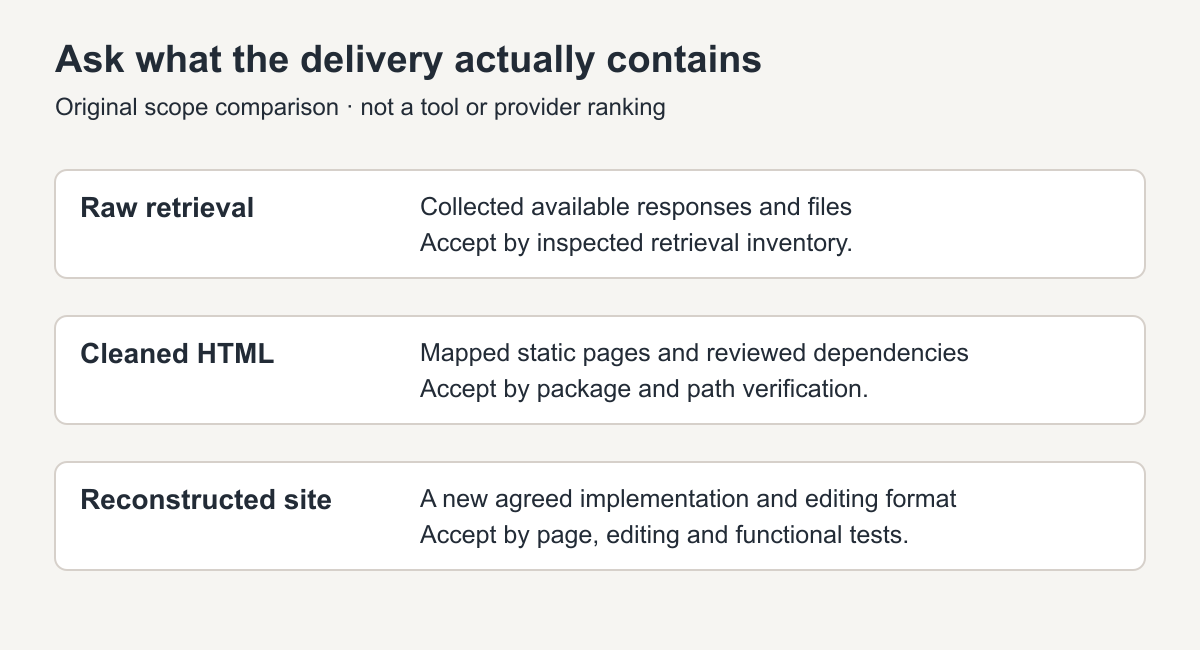
Original deliverables diagram. These are different scopes, not automatic quality rankings.
Compare observable deliverables
| Question | Raw archive retrieval | Cleaned HTML package | Reconstructed website |
|---|---|---|---|
| What is delivered? | Collected responses and available files | Reviewed static pages and organized dependencies | New agreed website implementation |
| Are references checked? | Depends on the specific tool and configuration | Should be part of the stated cleanup scope | Should be tested in the actual destination |
| What happens to absent assets? | They remain absent unless another source is used | Gaps are documented or approved replacements supplied | Owner-approved replacements or exclusions are implemented |
| How is content edited? | By inspecting and modifying the retrieved material | Normally through file editing unless another system is included | According to the chosen editor and agreed structures |
| Are forms or checkout operational? | Not established by retrieving visible pages | Requires separately agreed implementation | Only when specified, configured and tested |
| What proves completion? | Retrieval manifest and inspected results | Extracted package, path checks and missing-item record | Accepted page inventory, editing checks and functional tests |
Do not read “depends” as “always broken.” Some retrieval tools handle reference rewriting or related resources. Evaluate the particular output with a representative sample instead of assigning every automated process the same shortcomings.
The Internet Archive's documentation explains why archive content and dependent resources can be incomplete. No deliverable can silently turn an uncaptured original into recovered evidence. Additional design or copywriting must be identified as new work.
Know what a successful download does not establish
A retrieval can finish without demonstrating that you obtained the intended business version, every required page, all linked documents or compatible dates across resources. It can also preserve useful text when the old visual presentation is unavailable.
Inspection answers those questions. Select a required URL sample, open the collected files, check the response content and compare it with the agreed source references. If a package contains a parked-domain notice instead of the business homepage, the existence of an HTML file is not a satisfactory recovery result.
The HTML ZIP acquisition guide explains the source, working-copy and delivery-package distinction. If you already have retrieved files, supply their manifest and original capture references to a specialist rather than asking them to assume the collection is complete.
Choose according to who will maintain the result
Raw retrieval may suit a technically capable team that wants source material and will handle reconstruction themselves. Confirm that its acquisition process is permitted and that the resulting scope matches the required pages.
Cleaned HTML may suit a largely static website maintained through file changes. Its deployment still depends on the host's path handling and any agreed external functionality. Ask for the intended entry point, dependencies and a testable package.
A CMS rebuild may suit a team that will edit pages and articles regularly. For WordPress, recovered public material has to become new content structures unless a suitable original database survives. The WordPress backup handbook distinguishes the files and database needed for normal original-system restoration.
WordPress reconstruction also does not automatically mean native Elementor editing. If visual editing matters, specify that important sections must be editable through the agreed editor, rather than delivered as one embedded image or an opaque HTML block. Request a demonstration of the editing task on a representative page.
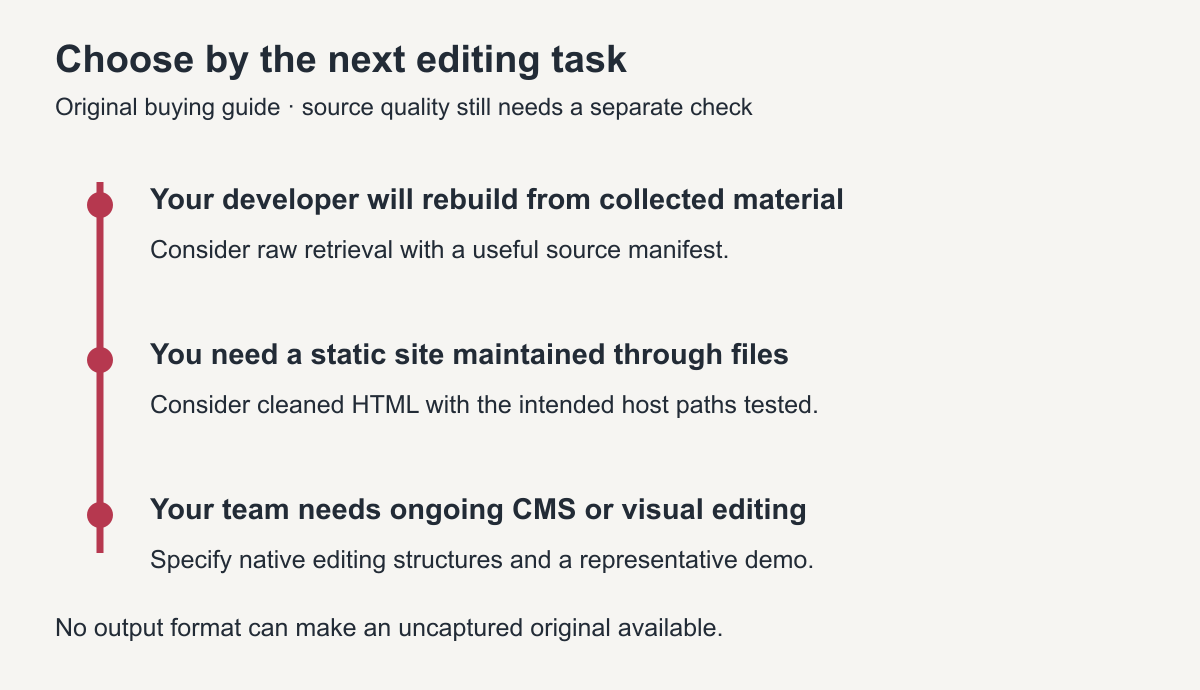
Original buying-decision guide. Editor choice and historical source availability are separate questions.
Ask these questions before accepting a quote
Use the following as a scope conversation, not a requirement that every project includes every feature:
- Which original URLs and source periods are included, and how are mixed versions handled?
- What exactly is supplied: source responses, cleaned files, an installed site, or editable page structures?
- Which images, documents and fonts were inspected, and what remains absent?
- What path, navigation and extraction checks are included?
- Which functions are newly implemented, and who supplies current business configuration?
- Who handles hosting deployment, access transfer and the final backup?
- What acceptance evidence and unresolved-item record come with the delivery?
Ask to see a representative deliverable or a clearly labeled demonstration when appropriate. Do not treat an unverified example, generic screenshot or broad “everything works” statement as evidence of your own project scope.
Wayback Downloader's HTML restoration is relevant when the agreed output is a reviewed static package. If you need a CMS or native visual editing, compare those service specifications separately rather than assuming they are included in an HTML delivery.
Your best choice is the smallest scope that supplies the usable sources, maintenance format and tested functions you actually need—with missing material and new work stated openly.
Wayback downloader vs website restoration: a quick decision table
| Choose | When |
|---|---|
| A downloader | You want raw files and can clean links, images and code yourself. |
| A download service | You want clean HTML files ready to upload, without the cleanup work. |
| A full restoration | You need an editable, working site with forms, hosting and testing done. |
Matching the option to your skills
Be honest about the time and technical skills you have. If editing HTML and fixing links is comfortable work for you, a downloader is a sensible start. If not, a cleaned download or a full restoration saves frustration.
More questions about downloaders and restoration
What is the main difference in a Wayback downloader vs website restoration?
A downloader saves what the archive holds. A restoration turns that material into a clean, working website and fixes what the archive missed.
Can I start with a downloader and upgrade later?
Yes. Raw files from a downloader can still be cleaned or rebuilt later.
Which option keeps my old URLs?
Any of them can, but restorations usually check and test every old address as part of the job.