
Published by Wayback Downloader.
An incomplete Wayback capture can support a website rebuild when enough reliable material survives for the agreed pages. The result may combine recovered public content, owner-supplied files and clearly identified new work. It cannot be presented as an exact historical restoration when essential originals are missing.
Not sure what survived? Start with a free archive review before you download anything. Or see the prices for each format.
The important question is not whether the archive looks incomplete—it often does—but whether its gaps prevent the business from getting a useful, honestly scoped website. Use a gap register to make that decision before building.
Classify the gaps before searching for replacements
Separate four kinds of absence: a whole page, an asset such as a photograph or document, styling or layout information, and application behavior. Each needs a different response.
A missing photograph may have an owner-supplied original. An unarchived service page may require newly approved copy. Missing CSS may leave readable content but require layout reconstruction; the missing-CSS diagnosis and reconstruction guide separates resource faults from new styling decisions. An old checkout or contact form requires current implementation and configuration; public appearance does not supply its lost private system.
The Internet Archive's Wayback guidance describes incomplete dependent resources and limitations of server-connected features. Use those limitations to classify actual findings, not to assume that every inaccessible item is permanently lost.
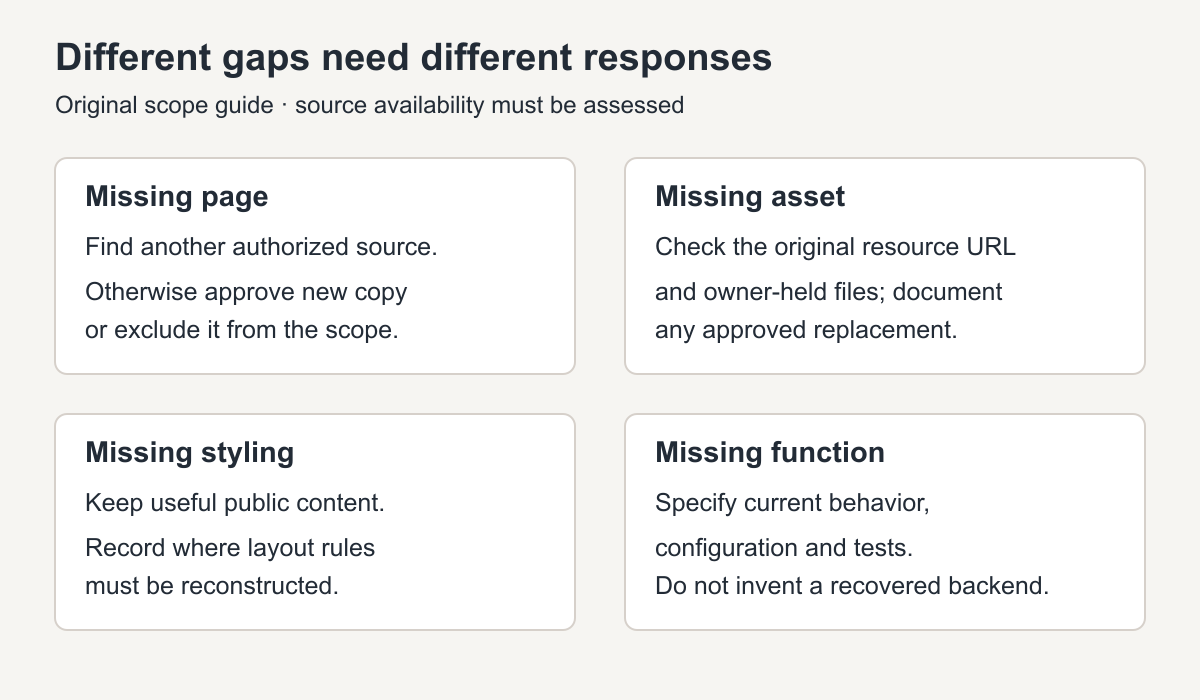
Original gap-classification diagram. A new implementation is not recovered historical backend code.
List the business impact too. Losing a decorative background does not have the same consequence as losing the only product specification sheet. Give essential items priority according to the task they support, not simply their file count.
Search additional sources with a defined stopping point
Inspect relevant earlier and later captures of the known original URL. For missing images or documents, inspect their original resource addresses where available. Check owner-held files and developer handovers alongside public evidence.
Record a useful source at item level. If a later capture supplies a logo, that does not make it suitable for the older service descriptions. If another date supplies a whole page, compare its identity, headings and business facts before combining it with the primary reference.
Choose a representative source version first using the snapshot-selection scorecard. Then search specific gaps. This avoids rebuilding one page from a succession of incompatible designs simply because each happens to contain something useful.
Agree a search limit in practical terms: which missing items, which relevant periods and which owner-controlled sources will be investigated. A failed search can end with an explicit unresolved finding. It should not turn into an open-ended promise that more searching must eventually find the original.
Use a gap register that separates evidence from decisions
The sample rows below are hypothetical planning examples, not a report of recovered client material. Replace the source notes and decisions with actual findings for your website.
| Required item | Source and date record | What is usable | Gap or uncertainty | Proposed decision |
|---|---|---|---|---|
| Service page | Full inspected capture URL and observed date | Main description | Hero photograph absent | Request original photograph; owner approves replacement if unavailable |
| Article | Selected capture and a separately recorded supplement | Body and one illustration | Download link lacks its file | Investigate document source or retire the link explicitly |
| Contact page | Owner-approved public reference | Address and visible labels | No current notification setup | Configure and test a new form separately |
| Product page | Inspected public capture | Description and reference image | Current price and stock unknown | Owner supplies current commerce data before launch |
| About page | No useful original source found | Owner's current company brief | Historical wording absent | Write new approved copy; label it as replacement work |
Add an owner, approval date and acceptance condition to each real row. Preserve the full capture reference rather than abbreviating it to a year. If no usable source has been found, say so; a proposed replacement is not a recovered asset.
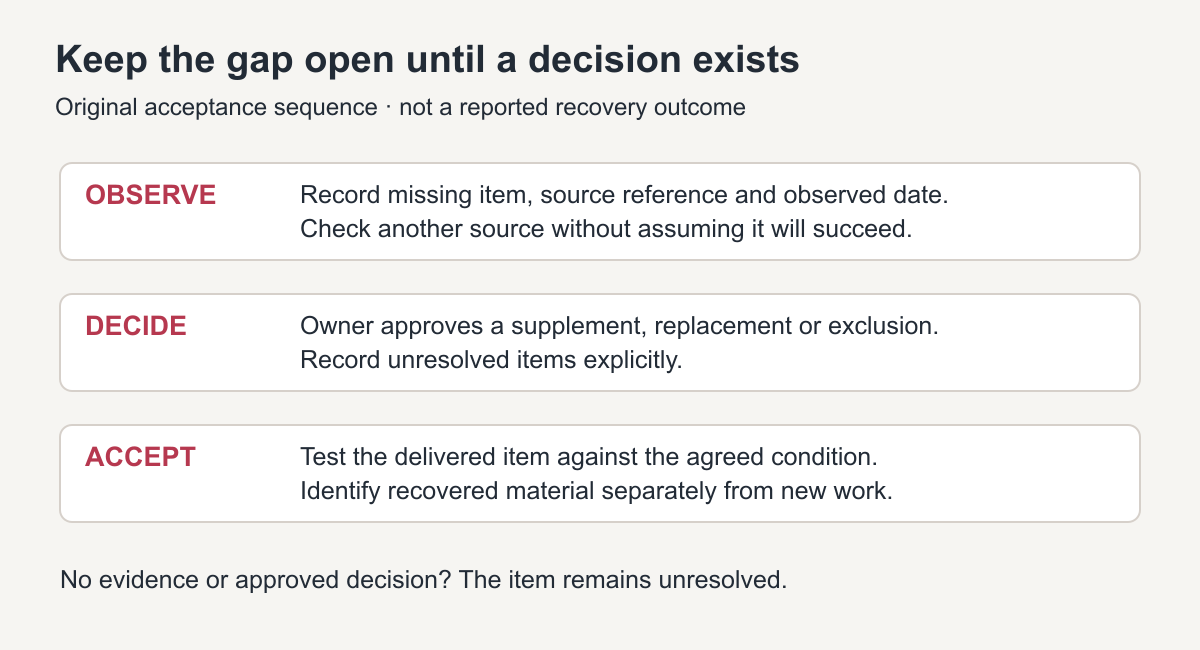
Original decision sequence. Unresolved items remain unresolved until evidence or an approved replacement decision exists.
Select a delivery route that fits the register
Faithful reconstruction is appropriate when the evidence supports the important content and visual structure, with any limited deviations documented. “Faithful” describes the agreed comparison standard; it should not imply exact source code or every historical function survived.
A partial delivery is appropriate when a defined set of useful pages can be completed while other material remains unavailable. State which sections are excluded and how navigation will avoid implying that missing destinations exist.
A redesign may be more practical when essential layout references are absent or the old structure no longer serves the business. Preserve useful authorized content, but describe new design decisions as new work. Do not make a newly invented layout look like evidence of the missing version.
An Elementor WordPress reconstruction can be relevant when the accepted content needs a new visually editable destination. Selecting an editor does not resolve evidence gaps: the register still determines what is recovered, replaced or excluded.
When a gap calls for a new presentation rather than faithful reconstruction, use the restore-or-redesign decision guide to approve preserved material and newly chosen design separately.
Test the unresolved edges, not just the completed pages
Review each accepted row against its source and decision. Check that replacement imagery is the approved file, that missing downloads have not become broken links, and that a partial launch's menus match its actual contents. Validate current facts with the owner before exposing obsolete archive information to customers.
For newly implemented functions, use an agreed test in the working destination. A form must do what was specified; a reproduced screenshot of its old fields is not a functional test. Keep sensitive test data out of public environments.
At handover, provide the remaining unresolved list as well as the completed inventory. Record which sources were combined and which material was created anew. That makes later expansion possible without pretending the first delivery recovered everything.
Can an uncaptured page be recovered exactly from neighboring pages?
Not if no source supplies its missing content or structure. Neighboring pages may show shared branding or navigation, but they cannot establish unseen wording. Seek another authorized source or agree new copy; do not infer an exact historical original.
A useful incomplete-archive project succeeds by matching its evidence and scope—not by hiding the gaps behind a finished-looking homepage.
Working with incomplete Wayback snapshots: quick checklist
- List which pages and assets are missing before you start.
- Check other capture dates for each gap.
- Use backups, emails and documents you still have.
- Rewrite or replace what cannot be found, and record it.
Frequently asked questions
How incomplete can Wayback snapshots be before a restore fails?
There is no fixed threshold. A site can still be worth rebuilding if its key pages exist, even when smaller pages and images are missing.
Can missing pages be rebuilt from other pages?
Shared parts such as headers and footers can, but the unique content of a missing page cannot be recreated exactly.
Should I wait for better snapshots?
No. The archive does not capture a site after it goes offline, so the existing captures are all there will be.